Civil engineering explained.
How deep do cables and pipes need to be laid? How does the house connection get into the building, with or without an impact mole? Which permits are required? Answers from the construction site, with guide values and sources.
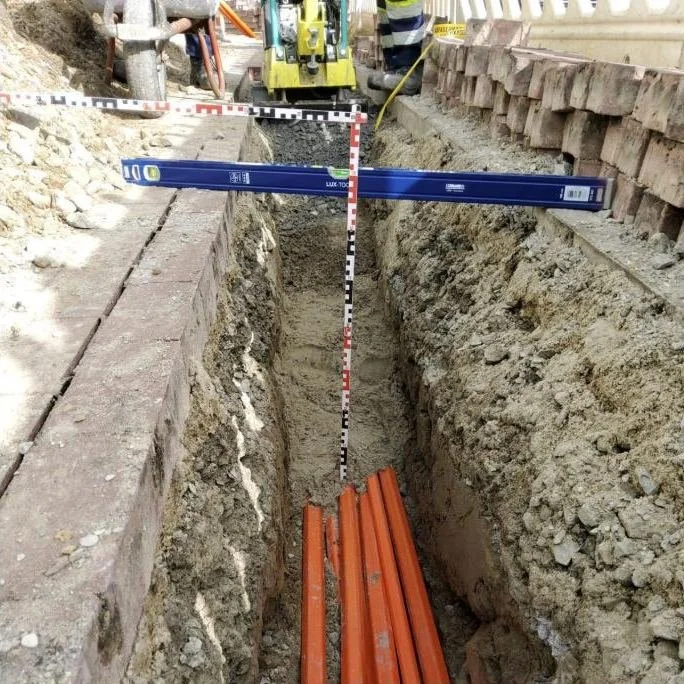
Civil engineering (Tiefbau) covers everything built below ground level: pipes, cables, house connections and the substructure of roads and paths. StoneCraft GmbH from Dinslaken handles all of this with its own crews, from the first excavation to the finished surface.
46539 Dinslaken
These are the questions we hear most often.
How deep must a power cable be laid in the garden?
0,6 mAt least 0.6 m, and 0.8 m under driveways. This is specified in DIN VDE 0100-520.
All depths →How deep is the trench for a fibre-optic house connection?
30 cmFor Telekom, at least 30 cm deep and 15 cm wide. Some other providers require more.
All depths →How deep must a water pipe be laid?
0,9–1,5 mDeep enough to be frost-free. The exact depth is set by the water supplier.
All depths →At what depth does a trench need to be secured?
1,25 mTrenches deeper than 1.25 m generally need sloped sides or shoring (DIN 4124).
More on safety →What civil
engineering covers.
Civil engineering is an umbrella term. On a single construction site, several areas often overlap, for example utility construction, earthworks and road construction.
Utility construction
Laying pipes and cables for electricity, water, gas and telecommunications in the ground, including crossings.
View service 02Earthworks
Excavation, soil replacement, formation level and backfilling. The foundation for everything that is built on top later.
View service 03House connections
From the footpath to the basement: trench or impact mole on the property, building entry and reinstatement.
View service 04Road & paving works
Base courses, asphalt, paving and footpaths. Newly built or reinstated after utility works.
View service 05Fibre rollout
Routes, empty ducts and house connections for fast internet. Utility construction with its own terms and rules.
View service 06Disposal
Excavated soil and construction rubble removed separately, recycled or disposed of. With documentation for invoicing.
View serviceFrom planning to acceptance in 8 steps.
Power cable, water pipe or fibre optics: most civil works sites follow the same sequence. That way everyone involved knows what happens next.
Planning & utility records
Define the route, depths and surfaces. Obtain the plans of all existing utilities beforehand.
Permits
Excavation permit from the local authority and a traffic order for the barriers.
Site set-up
Put up barriers and signage, provide machinery and materials.
Excavation
Cut the surface with clean edges, excavate the trench or pit, with shoring if required.
Laying
Lay pipes and cables on bedding at the specified depth, with warning tape above.
Backfilling & compaction
Backfill and compact layer by layer. Tested where required, for example with a plate load test.
Surface reinstatement
Install the base course, asphalt or paving properly, with clean transitions to the existing surface.
Measurement, documentation & acceptance
Record quantities, survey the utilities, document everything with photos. The basis for acceptance and invoicing.
Open-cut or trenchless.
The right method depends on the surface, available space, soil, obstacles and the local authority's requirements. Several methods are often combined. “In detail” explains how each one works.
Open-cut method
Open the surface, dig the trench, lay the line, backfill and close it again. The standard method in civil works.
Typical forUtilities in roads, footpaths and on private property
In detail
How it works: cut and break up the surface, excavate the trench, lay the line on bedding, place the warning tape, backfill and compact layer by layer, reinstate the surface.
Advantages: suitable for almost any utility and any soil. The line is visible and can be inspected and surveyed before backfilling.
Limitations: needs space and closes the footpath or carriageway. From a depth of 1.25 m, the trench generally needs sloped sides or shoring (DIN 4124).
Horizontal directional drilling (HDD)
A steered bore below the surface; the pipe is then pulled in.
Typical forBackbone routes and crossings under roads, railway tracks, watercourses or trees
In detail
How it works: from a launch pit, a steerable drill head bores beneath the obstacle. Drilling fluid, usually water with bentonite, supports the borehole and carries the cuttings out. The pipe is pulled in as the drill string is withdrawn.
Advantages: roads, tracks, watercourses and tree roots remain untouched, and traffic keeps flowing.
Limitations: complex equipment and site set-up, difficult in stony ground or rock. Existing utilities must be known precisely.
Impact mole (Erdrakete)
A soil displacement hammer drives itself through the ground over a short distance, pulling the pipe along behind it.
Typical forHouse connections under front gardens and driveways
In detail
How it works: a pneumatic hammer works its way from a launch pit to a reception pit, pushing the soil aside. The protective duct is pulled in at the same time or afterwards.
Advantages: front garden, driveway and paving stay intact; only two small pits are needed.
Limitations: only for short distances, cannot be steered and can be deflected by stones.
StoneCraft works with both open-cut and trenchless methods, including crossings. Find out more on the Services: Civil engineering & utility construction page and under House connections.
What lies beneath the surface.
A utility trench is built up in layers. Hover over a layer or tap it.
How the line gets
into the building.
A house connection links a building to the network in the street, for fibre, electricity, gas or water. On the property there are two options: under the surface with an impact mole, or in an open trench.
- 1Network in the footpathThis is where the connection is made.
- 2Launch pitSmall pit at the footpath or the property boundary.
- 3Impact moleDriven by compressed air in a straight line through the soil, pulling the protective duct with it.
- 4Reception pitSmall pit at the house wall. The front garden in between stays intact.
- 5Building entryCore-drilled hole through the basement wall, sealed against water and gas.
- 6Termination pointThe network ends here, e.g. at the house connection box (electricity) or the handover point (fibre).
- 1Network in the footpathThis is where the connection is made.
- 2TrenchExcavated continuously from the footpath to the house wall.
- 3Sand bedThe line or protective duct lies in sand, protected from stones.
- 4Warning tapeLies above the line and warns anyone digging there later.
- 5Building entryCore-drilled hole through the basement wall, sealed against water and gas.
- 6Termination pointThe network ends here, e.g. at the house connection box (electricity) or the handover point (fibre).
Under the front garden.
The impact mole is a hammer driven by compressed air. It pushes the soil aside and pulls the protective duct along behind it.
- Pits
- two small ones, at the footpath and at the house wall
- Distance
- short and straight, often around 10 m, up to approx. 25 m depending on the equipment
- Surface
- lawn, flower beds, paving and driveway stay intact
- Limitations
- stones, rubble, foundations, groundwater, bends
In detail
How it works: a compressor supplies compressed air at 6 to 7 bar. With rapid blows, the mole works its way from the launch pit to the reception pit. No soil is removed: the ground is pushed aside and compacted, creating a stable bore. The protective duct is pulled in at the same time or afterwards.
Alignment: the mole cannot be steered. It is aligned precisely with the target in the launch pit and then travels in a straight line. Bends are not possible; longer runs need additional pits.
No pit at the house: the mole can also be launched directly from a core hole in the basement. In that case, no pit is needed at the house wall at all.
Limitations: the soil must be displaceable. Stones, rubble or old foundations can deflect or stop the mole, and it does not work in groundwater. Because the soil is pushed aside, the mole needs enough cover above it, otherwise the surface may heave.
In an open trench.
The trench is excavated along its entire length, by excavator or by hand. The line lies in a sand bed with warning tape above.
- Trench
- continuous, dimensions specified by the network operator
- Distance
- any length, bends possible
- Surface
- is opened and then reinstated
- Good for
- long runs, stony ground, several utilities
In detail
How it works: remove the surface, excavate the trench, level the trench bottom. The line is placed in a sand bed, covered with more sand and a warning tape. The trench is then backfilled and compacted layer by layer and the surface is reinstated.
Advantages: works in almost any soil and over any distance. Existing utilities and obstacles are exposed, the depth can be kept precisely, and several lines fit into one trench.
Disadvantages: lawn, flower beds or paving have to be removed along the entire route, and reinstatement costs time and money. From a depth of 1.25 m, the trench must be secured in accordance with DIN 4124.
Example: where owners dig the trench themselves, MVV Netze requires a sand bed with 10 cm of sand below and 20 cm above the line. The trench is inspected and approved before laying.
The right option is decided at the on-site appointment. Both can also be combined, for example an impact mole under the driveway and a trench through the flower bed.
The process in 6 steps
- ApplyTo the network operator or fibre provider. For electricity, gas and water, with a site plan and floor plan.
- On-site appointmentAgree the route, building entry and space inside the building. Obtain utility records beforehand.
- Pits or trenchTwo small pits with an impact mole, otherwise a trench along the full length.
- Lay the ductThe impact mole pulls the protective duct through; in a trench, it lies in a sand bed.
- Into the buildingCore drilling, seal the building entry, pull in the line. Fibre is blown in.
- CloseBackfill and compact the pits, reinstate the lawn or paving.
Who does what?
Property owner
Applies for the connection and provides space and access inside the building. Owners can often dig the trench and do the core drilling on their own property themselves.
Network operator or provider
Plans the connection, lays the line and installs the termination point. Only the operator or a contractor it appoints may lay the line itself.
Civil engineering contractor
Pits, impact mole or trench, building entry and surface. On behalf of the network operator, a construction company or the owner.
How deep the lines must be laid is explained under Laying depths. StoneCraft carries out the civil works for house connections for network operators, construction companies and owners: House connections service.
How deep must
the line be laid?
There is no uniform statutory depth that applies throughout Germany. What counts are the generally accepted codes of practice (DIN, VDE, DVGW) and, above all, the requirements of the network operator or local authority. These guide values apply in practice:
| Utility | Guide value | Applies to | Basis |
|---|---|---|---|
| Power cable up to 1 kVe.g. NYY-J underground cable | min. 0.6 m | Gardens and areas without vehicle traffic | DIN VDE 0100-520 |
| Power cable under a driveway or carriageway | min. 0.8 m | areas with vehicle traffic | DIN VDE 0100-520 |
| Fibre-optic house connection2 × 7 mm microduct bundle or DN 75 empty duct | Trench min. 30 cm deep, 15 cm wide | Private property | Telekom specification |
| Fibre, reduced-depth trenchingempty ducts in a milled slot | 30 to 60 cm deep, 5 to 15 cm wide | paved surfaces | DIN 18220 |
| Gas house connection | generally 0.8 m cover | Private property | Network operator specifications, e.g. EWE NETZ |
| Water house connectionfrost-free | 0.9 to 1.5 m cover | Private property | Supplier specifications, e.g. GELSENWASSER: min. 0.9 m |
| Unsupported trenchvertical sides | up to 1.25 m deep | all trenches, subject to conditions | DIN 4124 |
Guide values without guarantee. In each individual case, the requirements of the network operator and local authority and the utility records apply. The sources are listed at the bottom of this page.
Bedding and warning tape
Cables are laid in sand, with about 10 cm below and above. A warning tape is placed above the sand layer to alert anyone excavating later.
Cover or trench depth?
Cover is the distance from the top of the line to the surface. The trench is deeper: with 90 cm of cover for a water pipe, the trench bottom is at about 1.0 m.
Do not build over
Gas and water connections must not be built over or planted with trees. The route must remain accessible for repairs.
Building safely.
For everyone.
An open trench is a hazard: for the team working in it and for everyone walking or driving past. Three rules apply on every site.
Secure the trench walls
Up to a depth of 1.25 m, trenches may be dug with vertical, unsupported walls under certain conditions. Deeper trenches generally need sloped sides or shoring (DIN 4124).
Secure the site
Barriers, signage and traffic lights on the road follow the RSA 21 guidelines for roadworks and the traffic order.
Protect existing utilities
Near existing utilities, excavation is done carefully, usually by hand rather than with the excavator bucket. The basis is the network operators' current plans.
What must be in place before breaking ground.
Whether a permit is needed depends mainly on where the digging takes place: on your own property or in the public highway.
On your own property
- A normal utility trench usually needs no building permit.
- Still obtain utility records: third-party lines often run across private land too.
- Follow the network operator's requirements on depth, position and spacing; do not build over the line.
- Depending on the utility, only the network operator or registered specialist firms may make the connection.
In the public highway
- Excavation permit or consent from the highway authority.
- Traffic order for barriers and signage (§ 45 StVO).
- Up-to-date utility records from all network operators.
- Surface reinstatement to the local authority's specifications.
Excavation permit
Issued by the local authority or the highway authority; for telecommunications lines, it takes the form of a consent. It often sets requirements for the construction period, position and surface reinstatement.
Traffic order
Issued by the road traffic authority; it governs barriers, signage and diversions during construction (§ 45 StVO).
Utility records request
Plans from all network operators show where electricity, gas, water, sewers and telecommunications lines already run. Many operators can be reached via the BIL portal. No digging without utility records.
Near groundwater, watercourses, railway facilities or trees, or in protected areas, further permits may be required, such as a permit under water law.
These documents help us most.
The more complete they are, the faster and more accurate the quote.
- Bill of quantities or tender documents
- Plans showing position, lengths and depths
- Soil report, if available
- Surfaces with quantities (asphalt, paving, unpaved)
- Time frame and preferred start date
- Scope: reinstatement, disposal, documentation
Every soil
is different.
How easily the soil can be excavated and where the spoil goes afterwards account for a large share of the cost. That is why both are already set out in the tender.
Homogeneous zones
In tenders, soil is now described in terms of homogeneous zones (Homogenbereiche). They have replaced the old soil classes 1 to 7 (VOB/C, DIN 18300).
Recycle or dispose
Excavated soil that leaves the site is usually classed as waste. Depending on contamination, it is recycled or disposed of. Since August 2023, much of this has been regulated nationwide by the Substitute Building Materials Ordinance (Ersatzbaustoffverordnung).
Separated and documented
We separate soil, construction rubble and asphalt on site. Analyses and disposal certificates are part of clean invoicing. More under Services: Disposal.
From the network node into the building.
Fibre optics is utility construction with its own terminology. Network level 3 (NE3) is the network in the street up to and into the building; this is where the civil works happen. Network level 4 (NE4) is the cabling inside the building.
← Swipe to scroll the graphic →
Connection to the building
From the empty duct in the footpath across the property, by trench or impact mole. Here's how it works: House connection explained.
Building entry
Professional penetration through the outer wall, sealed against water and gas.
APL installation
The handover point in the basement. This is where the operator's network ends.
What it looks like on site.
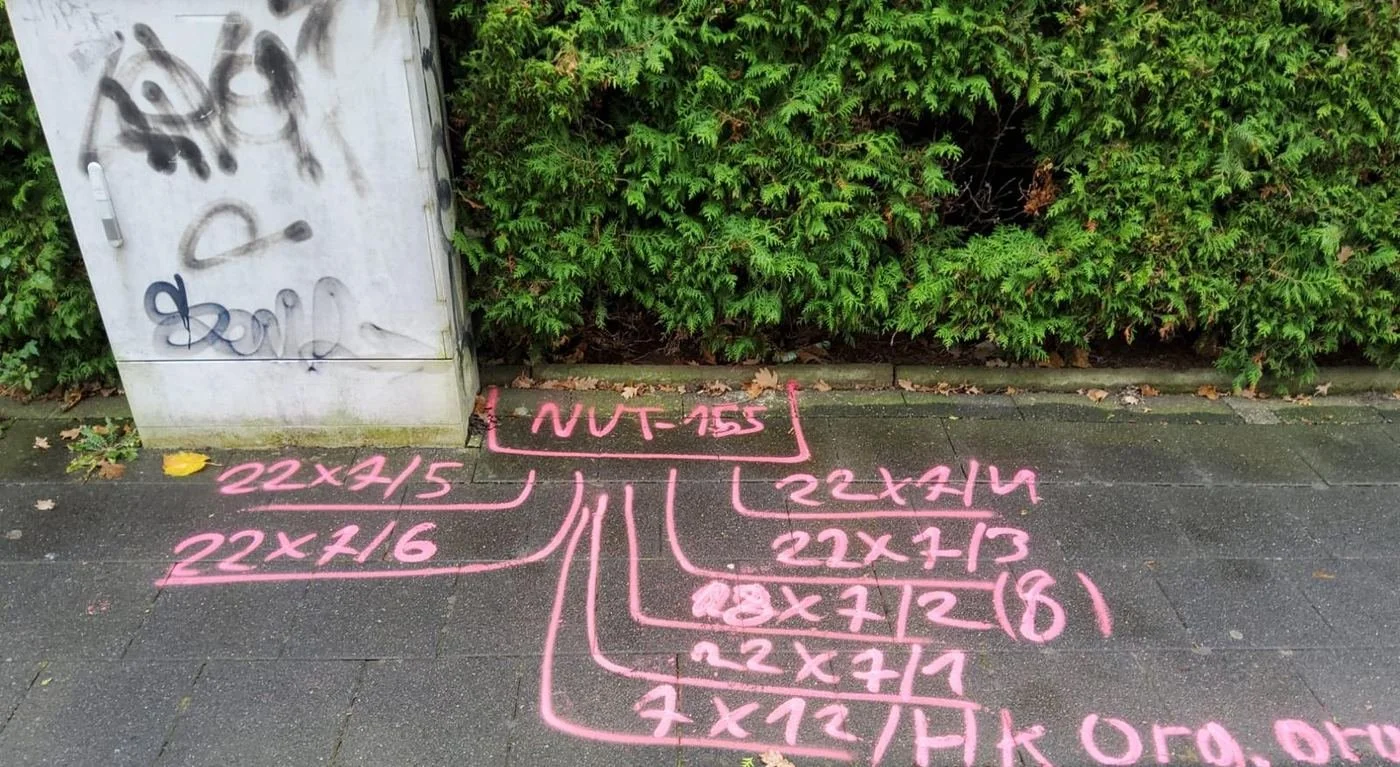
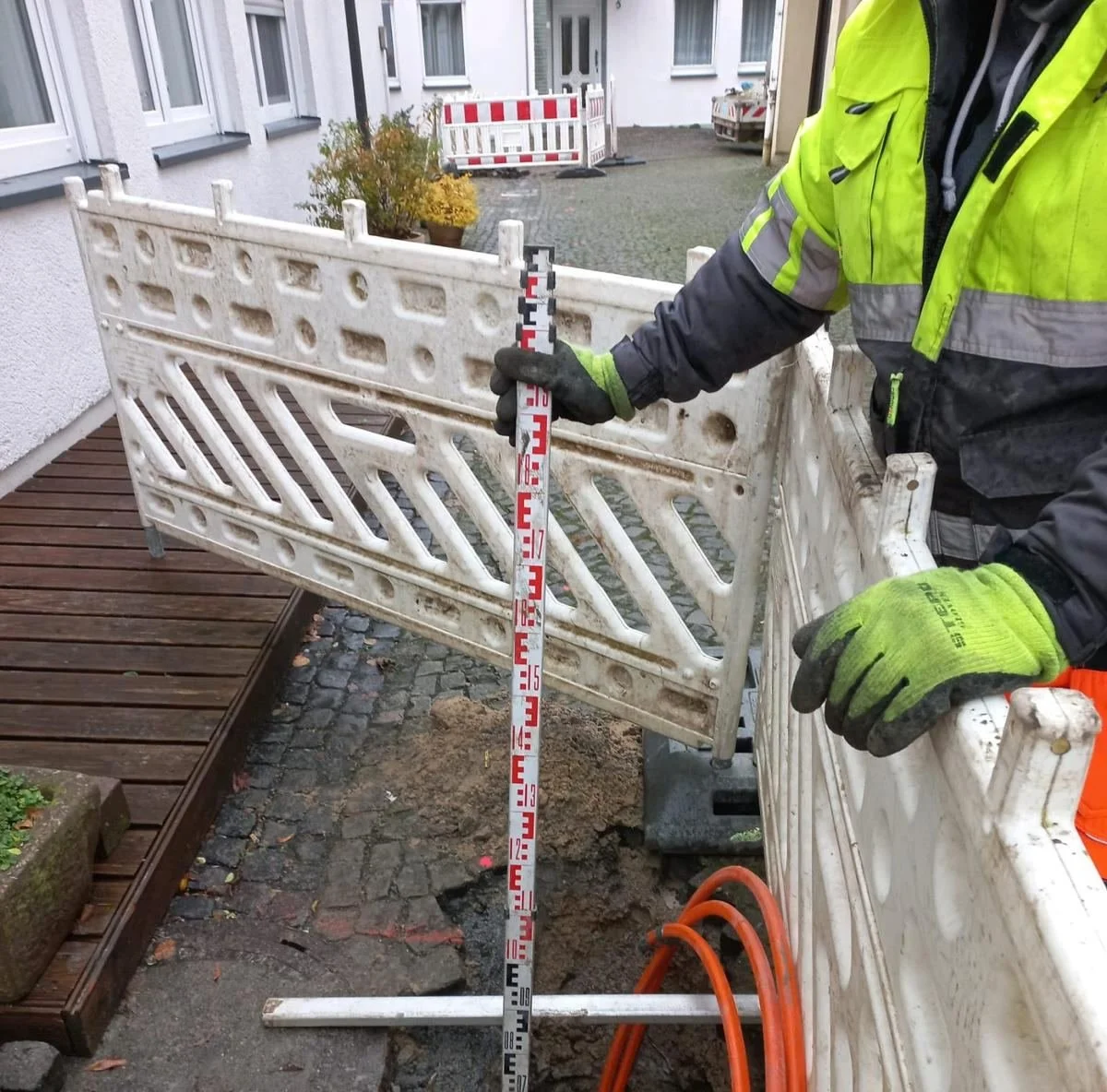
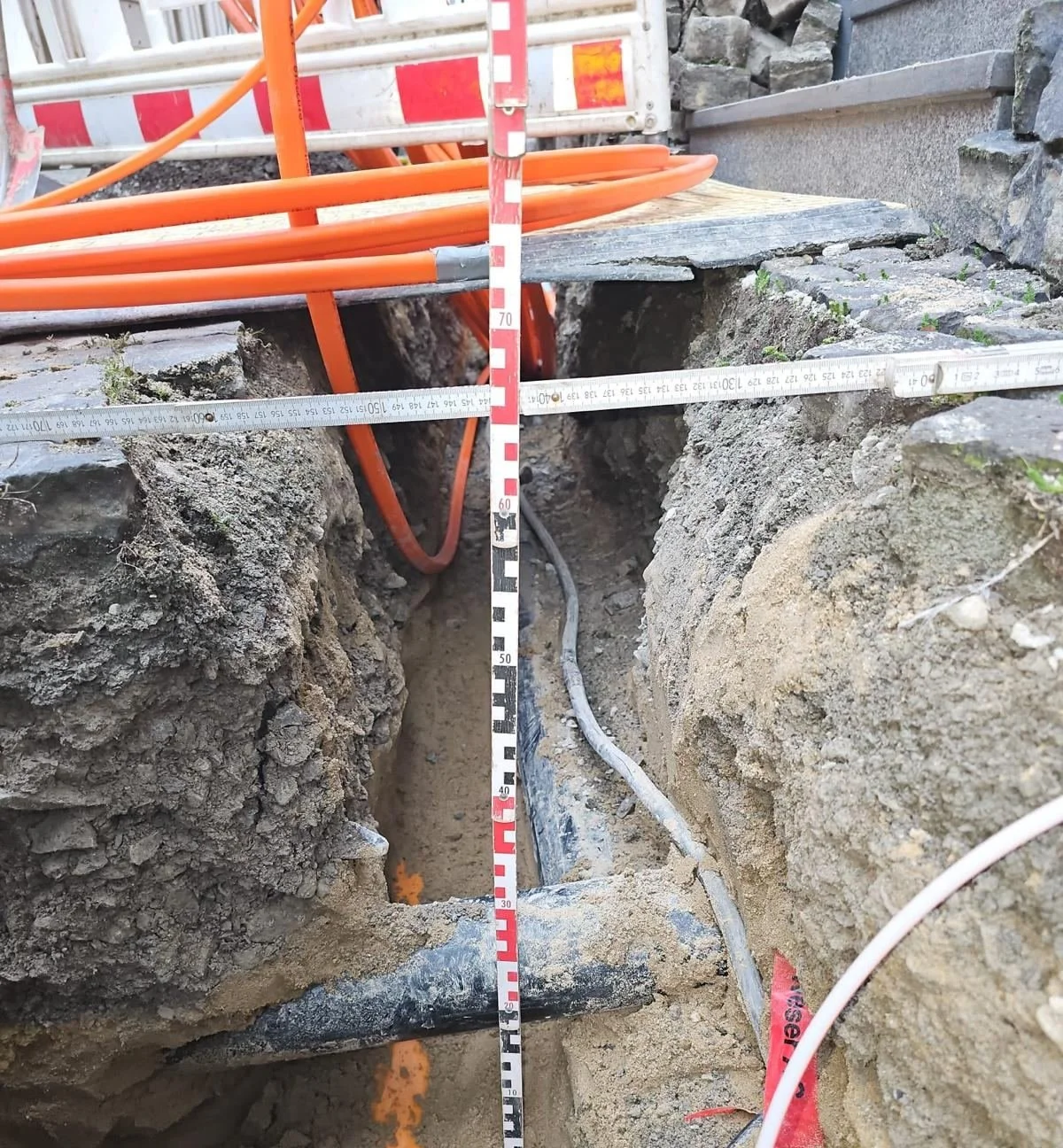
Real photos from our construction sites. You can find all projects and their locations on the project map.
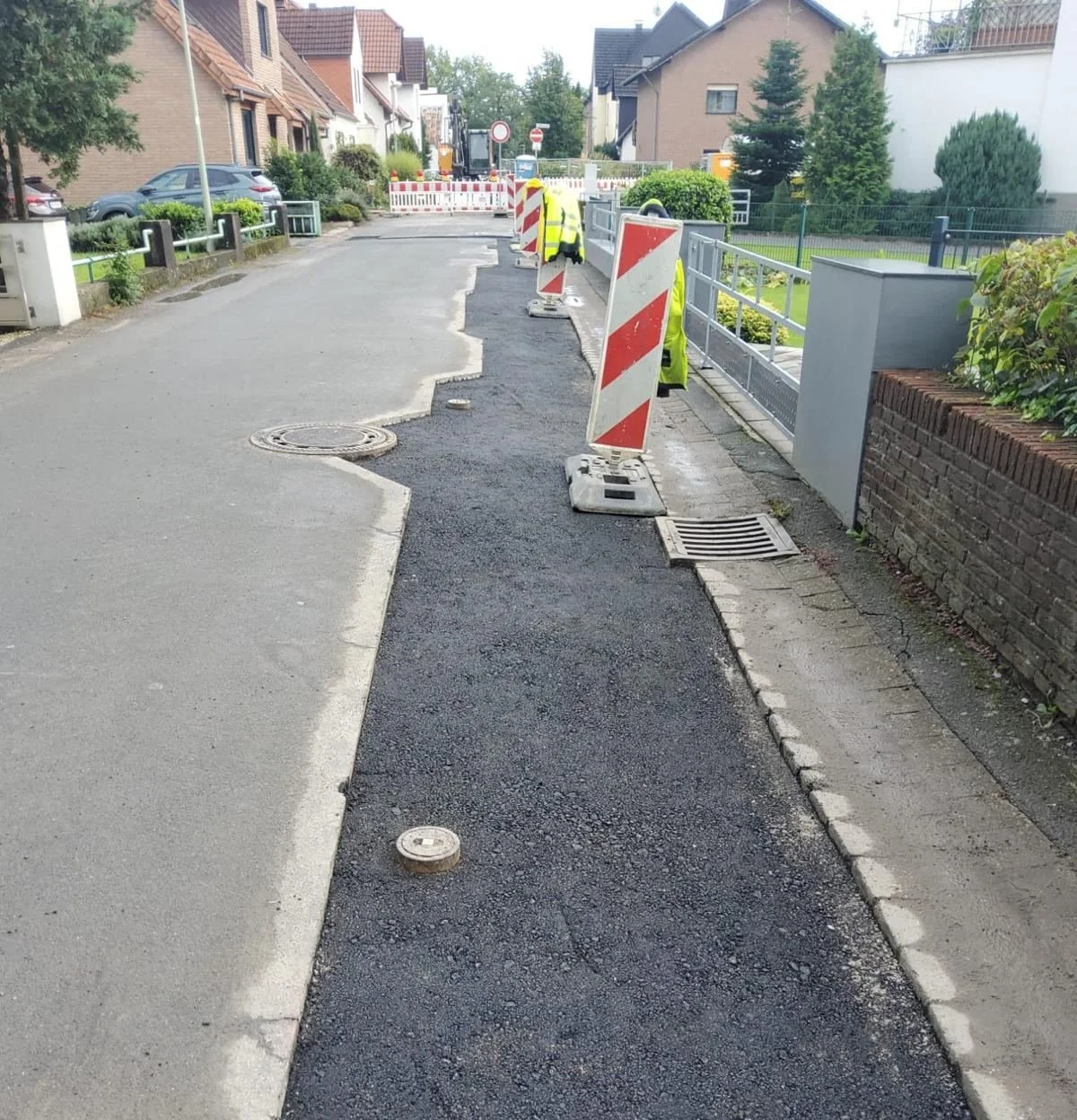
Civil engineering terms.
55 technical terms and abbreviations, explained briefly and clearly. Filter by topic or search directly.
The soil loosened during digging. It is stockpiled beside the trench, reused as backfill or removed from site.
Soil & trenchThe bedding for the line rests on it. It must be load-bearing and free of stones.
Soil & trenchClear space beside the line so that work and compaction can be carried out safely. Minimum dimensions are set out in DIN 4124.
Soil & trenchInstead of shoring, the trench wall is cut at an angle. Requires more space beside the trench.
Soil & trenchPanels or slide-rail systems that support the trench walls so that nothing slips in.
Soil & trenchSand or fine gravel below, beside and above the line. Protects it from sharp stones and pressure.
Soil & trenchDistance from the top of the line to the surface. Most network operator specifications state this value.
Soil & trenchDepth to which the ground does not freeze in winter. Water house connections are usually laid 0.9 to 1.5 m deep.
Soil & trenchSoil or substitute building material is placed back layer by layer, and each layer is compacted.
Soil & trenchThe soil is deliberately compressed so that the surface does not settle later.
Soil & trenchCharacteristic value for the bearing capacity of a layer. Shows whether compaction is sufficient.
Soil & trenchThe level subgrade surface, shaped to the specified profile, on which the next layer is placed.
Soil & trenchSoil or rock with similar properties. Replaced the old soil classes 1 to 7 in VOB/C.
Soil & trenchGroundwater or rainwater is pumped out or the water table lowered so that work in the trench can be carried out in the dry.
Soil & trenchSmall pits between which an impact mole or drilling rig operates. The surface in between stays intact.
Soil & trenchNetwork operators' plans showing where existing utilities run. Must be available before any excavation.
Utilities & connectionsElectricity, gas, water, wastewater, telecommunications or district heating. Each utility has its own rules and network operators.
Utilities & connectionsColoured tape above the line, printed with the type of utility. Warns anyone digging there later.
Utilities & connectionsDuct that protects cables in the ground and allows them to be replaced or added to later.
Utilities & connectionsPower cable with a robust sheath, approved for direct burial in the ground.
Utilities & connectionsLine from the network in the street into the building, for example for electricity, gas, water or fibre.
Utilities & connectionsSealed passage for a line through the basement wall or floor slab. Multi-utility building entries (MSH) bundle several lines.
Utilities & connectionsRound hole drilled through a wall or ceiling, for example for the building entry. Sealed afterwards.
Utilities & connectionsRoom in the building where the house connections come in, usually in the basement on the street side. In small houses, a wall or recess is sufficient.
Utilities & connectionsThis is where the network operator's power cable ends inside the house. From here it continues to the meter cabinet.
Utilities & connectionsPoint where a line crosses an obstacle, either by open-cut excavation or by trenchless drilling.
Utilities & connectionsSteered bore without an open trench, for example under a road.
Utilities & connectionsCompressed-air hammer that pushes the soil aside instead of excavating it. Travels only in a straight line and pulls a pipe in behind it; typical for house connections.
Utilities & connectionsFibre all the way into the flat or house. The fastest type of connection.
Fibre opticsFibre into the building, usually to the basement. Inside, the connection continues over existing wiring.
Fibre opticsCentral network node from which a rollout area is supplied with fibre.
Fibre opticsDistribution point in the street between the PoP and the individual buildings.
Fibre opticsThe fibre network in the street up to and into the building, including the house connection. This is where civil works come in.
Fibre opticsThe cabling inside the building, from the building entry point to the individual flats.
Fibre opticsLine termination point (Abschlusspunkt Linientechnik) in the building. This is where the operator's network ends.
Fibre opticsThin empty duct into which the fibre is blown. Several microducts form a microduct bundle.
Fibre opticsThe fibre-optic cable is pushed through the empty duct with compressed air, often over several hundred metres in one go.
Fibre opticsInstallation in a narrow milled or cut slot. The rules for this are set out in DIN 18220.
Fibre opticsOpening up asphalt or paving, usually with cleanly cut edges.
RoadsThe surface that is driven or walked on, for example asphalt or paving.
RoadsLayer of crushed stone or asphalt that distributes the loads from above.
RoadsLower base layer of gravel or crushed stone. Protects the road from frost damage.
RoadsProper closing of the surface, technically equivalent to its previous condition.
RoadsGuidelines for safeguarding work sites on roads (Richtlinien für die Sicherung von Arbeitsstellen an Straßen), currently RSA 21. They govern barriers and signage.
RoadsPermission from the highway authority to dig up a public area. Often includes conditions on construction time and reinstatement.
Permits & contractsOrder (verkehrsrechtliche Anordnung) issued by the road traffic authority under § 45 StVO for barriers, signage and diversions.
Permits & contractsThe body responsible for a road, for example the local authority, district, federal state or federal government. It approves excavations.
Permits & contractsGerman Construction Contract Procedures (Vergabe- und Vertragsordnung für Bauleistungen). Part C contains the technical rules, for example DIN 18300 for earthworks.
Permits & contractsList of all work items with quantities. The basis for the quote and invoicing.
Permits & contractsRecording of the quantities actually built. The basis for invoicing.
Permits & contractsFormal handover of the completed work to the client. The warranty period starts from this point.
Permits & contractsCompany that carries out part of the work on behalf of another construction company.
Permits & contractsCompany that takes on the overall contract and awards parts of it to subcontractors.
Permits & contractsWork the owner takes on personally, for example the trench and core drilling on their own property. The network operator lays the line itself.
Permits & contractsStandard for slopes, shoring and working space widths in excavations and trenches.
Permits & contractsNo term found. Feel free to ask us directly.
Frequently asked questions.
28 answers on laying depths, trenches, permits and StoneCraft. Short, with guide values and sources.
Laying cables and pipes
How deep does a power cable need to be laid in the garden?
Under DIN VDE 0100-520, an underground cable up to 1 kV, for example NYY-J, is laid at least 0.6 m deep, and at least 0.8 m deep under driveways and carriageways. It is bedded in sand, about 10 cm below and above, with a warning tape above the sand layer. The cable may only be connected by a registered electrical contractor.
Is there a statutory minimum depth for cables and pipes?
There is no uniform statutory depth that applies throughout Germany. What counts are the generally accepted codes of practice, i.e. DIN, VDE and DVGW rules, and the requirements of the network operator concerned. On public roads, the conditions of the local authority's excavation permit also apply.
How deep is a fibre house connection laid?
That is set by the provider. Telekom, for example, requires a trench on the property at least 30 cm deep and 15 cm wide for a microduct bundle of two 7 mm tubes or a DN 75 empty duct. Some other providers specify greater depths.
How deep must a water pipe be laid?
Deep enough to be frost-free. For house connections, water suppliers usually require between 0.9 m and 1.5 m of cover; GELSENWASSER, for example, requires at least 90 cm. The trench is correspondingly deeper: about 1.0 m for 90 cm of cover.
How deep is the gas pipe to the house?
Gas house connections usually have about 0.8 m of cover, as stated, for example, in the connection conditions of EWE NETZ. The pipe itself is laid by the network operator. Gas and water connections must not be built over or planted with trees.
What does reduced-depth installation mean for fibre?
With the highway authority's consent, fibre ducts may be laid shallower and narrower than conventional utility lines. DIN 18220 sets the rules: when milling in paved surfaces, the slot is 5 to 15 cm wide and 30 to 60 cm deep; when saw-cutting, it is 1.5 to 11 cm wide.
Can you build over utility lines or plant trees above them?
Under the network operators' connection conditions, gas and water service pipes must not be built over or planted with trees, and the route must remain accessible. The route above power and fibre lines should also be kept clear so that they can be reached in the event of a fault.
House connection
How does a house connection work?
A protective duct or line is laid from the network in the footpath across the property to the wall of the house, using an impact mole or in an open trench. The line enters the house through a core-drilled opening, and the building entry seals it against water and gas. Inside, the network operator installs the termination point, for example the house connection box for electricity or the building entry point for fibre. Finally, the pits or trench are backfilled and the surface is reinstated.
What is an impact mole?
A hammer driven by compressed air that forces its way through the ground. It pushes the soil aside and compacts it instead of excavating it. The protective duct is pulled into the resulting bore either straight away or afterwards. An impact mole cannot be steered and only travels in a straight line.
When can a house connection be made without a trench?
With an impact mole, if the run is short and straight and the soil can be displaced. Two small pits are then enough, and the front garden, paving and driveway stay untouched. Stones, construction rubble, old foundations or groundwater rule it out, in which case an open trench is dug. Whether it is feasible is clarified during the site visit.
How far can an impact mole travel?
Depending on the equipment and soil, up to about 25 m, according to the manufacturer TRACTO-TECHNIK. For fibre house connections, WEMAG, for example, assumes about 10 m per run. For longer distances, additional pits are dug.
Can I dig the trench for my house connection myself?
Often yes, if the network operator allows it. At EWE NETZ, for example, customers may dig the trench, backfill it and reinstate the surface; at MVV Netze they may also do the core drilling. The network operator lays the line itself; at MVV Netze the trench is inspected and approved beforehand. Electrical connections may only be made by a contractor listed in a network operator's register of installers (§ 13 NAV).
Where does the line enter the house?
Usually in the basement or the house connection room, ideally on the street side. The requirements for house connection rooms, walls and recesses are set out in DIN 18012. New builds often get a multi-utility building entry that brings several lines, for example electricity, gas and water, into the house together through one sealed opening.
How long does a house connection take?
The construction work itself is usually quick; depending on the soil, an impact mole can manage up to 15 m per hour. The preparation often takes longer: for electricity, gas and water, Netze Duisburg, for example, quotes several weeks for preparing the quotation and a few more weeks until an appointment is scheduled. In fibre rollouts, connections go live once the local network is complete.
Trenches, safety and permits
At what depth does a trench need to be secured?
Under DIN 4124, trenches up to 1.25 m deep may, under certain conditions, be dug with vertical sides and no support. Deeper trenches generally need sloped sides or shoring. Soil type, loads at the edge of the trench and water are also decisive.
How wide does a utility trench need to be?
That depends on the depth, the line and the working space. For a fibre house connection, Telekom accepts 15 cm; for a water house connection, GELSENWASSER requires at least 60 cm. If people enter the trench, DIN 4124 specifies minimum widths for the working space.
Do I need to obtain utility records before digging?
Yes, even on your own property. Network operators provide plans of their lines, often online, many of them, for example, via the BIL portal. Anyone who digs without utility records and damages a line risks being held liable for the damage.
What should I do if a line is damaged during digging?
Stop immediately and secure the area. If you smell gas: no ignition sources and no mobile phones in the danger zone; clear the area and call the fire brigade (112) and the network operator's emergency service. Keep your distance from power cables. Report even minor damage to the sheath, as it often leads to failures later.
Which permits do you need for civil works on public roads?
Usually three: the excavation permit or consent from the local authority or highway authority, a traffic order from the road traffic authority for barriers and signage, and up-to-date utility records from all network operators. Depending on the location, further permits may be needed, for example a permit under water law.
Do I need a permit to dig on my own property?
For a normal utility trench on your own property, usually not. Even so: obtain utility records, follow the network operator's requirements and check with the local authority beforehand if trees, property boundaries or larger excavations are involved.
Construction methods, costs and process
What is the difference between open-cut and trenchless methods?
With the open-cut method, a trench is excavated and then closed again. With the trenchless method, the surface remains almost untouched: the line is pulled in underground by horizontal directional drilling (HDD) or an impact mole, and only launch and reception pits are needed.
What do civil engineering costs depend on?
Mainly on length and depth, the soil, the surface (asphalt, paving or unpaved), shoring and dewatering, traffic management, and how the excavated material is recycled or disposed of. With a bill of quantities and drawings, we can provide an accurate quote.
What does civil engineering cover?
Civil engineering in the sense of Tiefbau covers everything built below ground level: utility construction for electricity, gas, water and telecommunications, earthworks, sewer construction and the substructure of roads and paths. Several of these areas often overlap on a single construction site.
About StoneCraft
What does StoneCraft GmbH do?
StoneCraft is a civil engineering contractor from Dinslaken. We handle civil works and utility construction, earthworks, house connections, road construction and paving, fibre rollout and horizontal directional drilling (HDD) for backbone routes, using both open-cut and trenchless methods. We also reinstate surfaces and handle disposal with documentation.
Which regions does StoneCraft work in?
Our focus is the Ruhr area, the Lower Rhine and NRW. From our head office in Dinslaken, we can reach Duisburg, Oberhausen, Wesel, Voerde, Bottrop and Essen quickly. We have also completed projects in Lower Saxony, Hesse, Saxony-Anhalt and Saxony, in places including Münster, Gelsenkirchen, Neuss, Leverkusen, Wuppertal, Bocholt, Paderborn, Garbsen, Frankfurt am Main, Halberstadt, Chemnitz and Dresden. All locations are shown on the project map.
Who has StoneCraft worked for?
Mainly for construction companies. As a subcontractor to the contractors appointed in each case, we have worked on rollout projects for the networks of SachsenEnergie, Telekom, 1&1, Deutsche Glasfaser, Vodafone, Westconnect and UGG (Unsere Grüne Glasfaser). We also take on contracts directly, for example from network operators, municipal utilities, local authorities and businesses.
Does StoneCraft also handle reinstatement and disposal?
Yes. We reinstate asphalt, paving and footpaths to specification. Excavated material and construction rubble are separated and recycled or disposed of with documentation.
How do I get a quote?
Send us your bill of quantities, drawings or key details via the enquiry form or to info@sc-stonecraft.de, or call us on 02064 7322442. We will get back to you promptly with any questions and a quote.
SourcesShow standards, regulations and 14 technical sources
Standards and regulations: DIN VDE 0100-520 (cables and wiring, laying depth of underground cables) · DIN 4124 (excavations and trenches) · DIN 18012 (house connection facilities) · DIN 18220 (reduced-depth installation) · DIN 18300 and VOB/C (earthworks, homogeneous zones) · RSA 21 · § 45 StVO · § 13 NAV · Substitute Building Materials Ordinance.
- Telekom: Construction preparation for property owners: fibre house connection
- BMDV / Gigabitbüro: Application guide to DIN 18220 (trenching, milling, ploughing), as of March 2025
- EWE NETZ: Technical connection conditions for gas
- Stadtwerke Dreieich: Technical connection conditions for gas
- GELSENWASSER: Notes on the water house connection (via Hertener Stadtwerke)
- Stadtwerke Forst: Technical notes on the drinking water house connection
- Stadtwerke Friedberg: Notes on planning the drinking water house connection
- BIL eG: Nationwide portal for utility records requests
- TRACTO-TECHNIK / Gigabit.NRW: Workshop on alternative installation methods: the impact mole, how it works and its limits of use
- grabenlos.at: Process description: soil displacement method (impact mole)
- Hauff-Technik: Technical article: Trenchless installation of broadband house connections (3R, 2013)
- WEMAG: Brochure on the fibre house connection
- Netze Duisburg: Network connection brochure 2025 (electricity, gas, water)
- MVV Netze: Customer information: owner's own work for network connections
Didn't find your question?
Call us or send us your documents. We will reply promptly.